How Does Satellite Internet Work, and Why Is It Suddenly Everywhere?
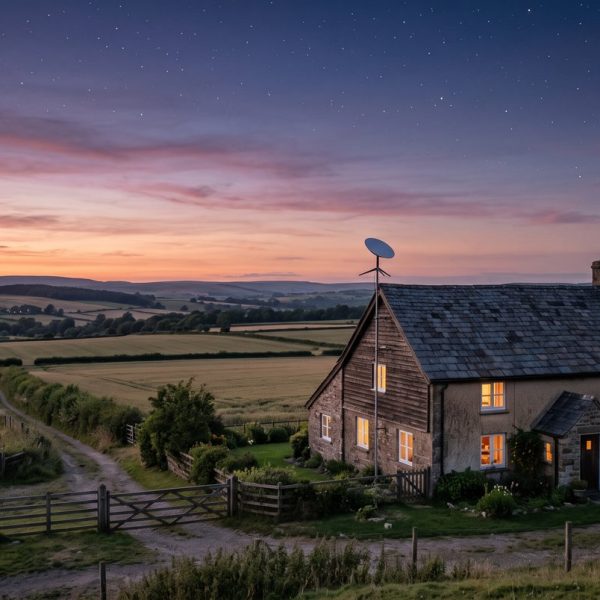
For most of the internet's history, getting online meant a physical link: a cable in the ground or a phone line running to your house. That is quietly changing. Constellations of small satellites now beam broadband down from orbit to places wires never reached. If you have ever wondered how does satellite internet work, and why it has gone from a niche last resort to front-page news, the answer is a mix of old physics and some genuinely new engineering.
What is satellite internet, really
So what is satellite internet? At its simplest, it is a way of connecting to the internet through radio signals bounced off satellites rather than through cables. You have a dish or antenna at your home, a satellite acts as a relay in the sky, and somewhere on the ground a station links the whole thing to the wider internet. The idea is decades old. What has changed is where the satellites sit and how many of them there are.
How does satellite internet work, step by step
The path your data takes is worth tracing, because it explains both the promise and the limits. When you load a page, your dish sends a request up to a passing satellite. The satellite relays that signal down to a ground station, often called a gateway, which is wired into the ordinary internet. The response makes the return trip: gateway, satellite, your dish. All of this happens in a fraction of a second, but the distance the signal travels is the key variable. The farther away the satellite, the longer the round trip, and the more sluggish everything feels.
The leap from far orbit to low orbit
Traditional satellite internet used a handful of large satellites parked in geostationary orbit, roughly 36,000 kilometres up. From that height a single satellite can cover a third of the planet, which is efficient, but the signal has to travel about 72,000 kilometres on the round trip. That built-in lag made video calls painful and gaming close to impossible. The new generation flips the trade. Companies launch thousands of small satellites into low Earth orbit, only a few hundred kilometres up, so signals return far faster. The catch is that each satellite covers a small patch and races across the sky, which is why you need so many of them working together as a swarm.
The satellites you already rely on
None of this is as exotic as it sounds, because satellites are already woven into daily life. The same basic idea, a device on the ground talking to hardware in orbit, is what happens every time your phone finds its location or you open an app to measure distance on a walk. Satellite internet simply pushes that relationship further, using the sky to carry not just a position but a full broadband connection.
Who satellite internet is actually for
The technology matters most where the ground-based internet gave up. Satellite internet for rural areas, remote farms, ships, disaster zones and mountain villages is often the only realistic option, and low Earth orbit has made it fast enough to be genuinely useful rather than a grudging fallback. That reach carries real economic weight. A business in a remote region can suddenly sell to the world, and reaching those new customers well often means translating documents and communications for markets that were previously out of range. Connectivity is the first step, but it opens the door to a great deal more.
Satellite connectivity has quietly changed what it is safe to attempt in places with no cell coverage, and nowhere is that more obvious than in the American backcountry. Even with a signal overhead, the planning still happens before you leave, which is why experienced drivers study a us national parks map rather than trusting turn-by-turn directions to understand terrain. A connection tells you where you are; the map tells you whether the day you have planned is realistic.
Satellite connectivity has changed what rural viewers can watch live, which matters more for sport than for almost any other content. Delayed coverage is barely worth having. Fans following the cleveland cavaliers from outside the broadcast region were among the earlier adopters for exactly that reason.
Is satellite internet good, or just better than nothing?
The honest answer to whether is satellite internet good is that it depends on your alternatives. Where you already have fibre, it is usually slower and pricier, and heavy weather or a blocked view of the sky can still interrupt it. Where you have nothing, or a creaking old connection, the newer low-orbit services can be transformative. It is best judged not against the fastest city broadband but against the real choice in front of you. For a deeper technical rundown, the overview of satellite internet access is a solid primer, and communities such as the r/Starlink forum are full of users comparing real-world speeds in the places that matter.
The crowded sky problem
All those satellites come with a cost of their own. Low Earth orbit is filling up quickly, and the more hardware we launch, the higher the risk of collisions and drifting debris. Operators now spend real effort tracking objects and nudging their satellites out of harm's way. It is a reminder that the sky is not infinite, and that the same orbits carrying your internet also have to stay clear enough to keep carrying it.
Satellite internet will not replace the cable running to a city apartment any time soon. But for the billions of people and the countless places that fast wires never reached, a connection from orbit is turning from science fiction into something you can bolt to a roof. The sky, it turns out, makes a surprisingly good internet cable.