How Modern Satellites Shape Daily Life and Space Exploration
Look at your phone for directions, check tomorrow's forecast or watch a live event from another continent, and you are probably using a satellite without noticing it. Space technology has moved from rare, government-run missions to a daily utility that millions of people depend on. This article explains how satellites work, what they are used for and where exploration is going next.
What a satellite actually is
A satellite is an object that orbits a larger body. Natural examples, such as the Moon, circle the Earth. Artificial satellites are built by people and launched into orbit to perform a task.
They stay in orbit because of a balance: they move sideways fast enough that, as gravity pulls them down, the curve of the Earth falls away beneath them.
A satellite never escapes gravity, it simply keeps falling around the planet.
The main types of orbit
Low Earth orbit sits a few hundred kilometers above the surface. Satellites there circle the planet in about ninety minutes and are used for imaging, science missions and some communication networks.
Medium Earth orbit hosts navigation systems. Geostationary orbit, about thirty-six thousand kilometers up, matches the Earth's rotation, so a satellite appears fixed in the sky. This is ideal for television broadcasting and weather observation.
What satellites do for us
Navigation satellites allow phones, ships and aircraft to find their position. Weather satellites track storms and help forecasters warn communities in time. Communication satellites link remote villages, ships and aircraft to the internet.
Earth observation satellites monitor crops, forests, glaciers and urban growth. Farmers use them to plan irrigation, and emergency teams use them to map floods and wildfires.
How a launch works
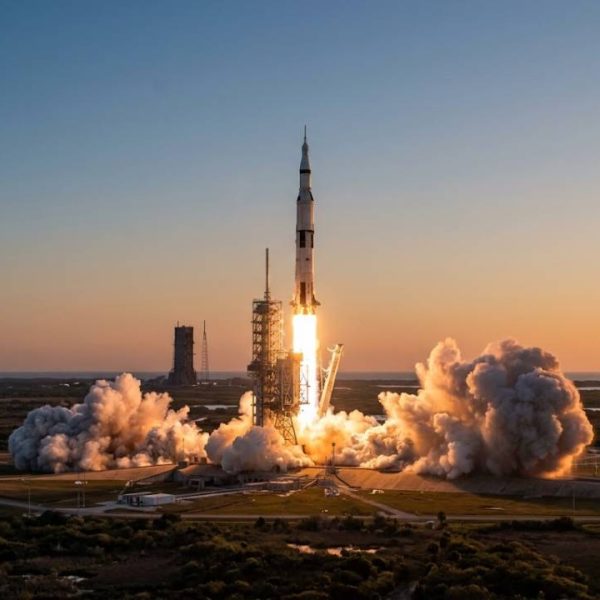
A rocket must reach very high speed, about eight kilometers per second, to place a payload in low orbit. Most of its weight is fuel, and it is built in stages that are dropped as they are used up.
Agencies such as NASA publish launch schedules, mission explanations and images that make it easier to follow each step.
Reusable rockets and lower costs
For decades, rockets were used once and discarded. Reusable boosters that land and fly again have lowered costs and made frequent launches possible. More affordable access to orbit has encouraged universities, small companies and developing countries to build their own satellites.
Space debris and sustainability
With more satellites come more risks. Old satellites and fragments of rockets circle the Earth at high speed and can damage working spacecraft. Operators now plan how to move satellites out of orbit at the end of their life, and tracking networks warn of possible collisions.
Keeping orbit clean is a shared responsibility, because a single collision can create thousands of new pieces.
Exploration beyond Earth orbit
Robotic probes have visited every planet in the solar system, and rovers study the surface of Mars. Space telescopes look back billions of years, revealing galaxies and distant planets.
Human exploration is also moving forward, with plans for lunar stations and longer missions. These projects require cooperation between many countries, each with its own language, standards and rules.
Working together across borders
Space missions rely on international teams. Engineers, scientists and lawyers from different countries must agree on technical specifications, safety rules and data sharing. At conferences and joint reviews, professional interpreting services help experts discuss complex topics in real time without losing precision.
Sensitive information also needs protection. This guide to confidential translation services shows how organizations handle private technical material across languages.
Careers and education
The space sector needs more than astronauts. Software developers, mechanical engineers, data analysts, project managers and communicators all play a role. Students can begin with physics, mathematics and programming, then explore internships, university competitions and amateur satellite projects.
How to follow space news
Start with official agency websites and well-known science outlets. Look for mission names and dates, and be careful with dramatic headlines about discoveries that have not yet been confirmed.
Observation events, such as meteor showers or visible satellite passes, are easy and free ways to feel connected to the field. A pair of binoculars is often enough.
Satellites and climate science
Instruments in orbit measure sea level, ice cover, ocean temperature and greenhouse gases over decades. Because they cover the whole planet in the same way, they provide data that ground stations alone could never collect. Researchers combine these records with local measurements to improve climate models and to track how forests and farmland change from year to year.
Space tourism and the commercial boom
Private companies now launch cargo, build satellites for customers and plan flights for paying passengers. This brings new energy and investment, but it also raises questions about safety, fair access and environmental effects. Clear international rules help balance innovation with responsibility.
Why it matters
Space exploration is not only about distant worlds. Technologies developed for orbit have improved medical imaging, materials, water filtration and communication on the ground. Learning how satellites and rockets work helps us understand both the opportunities and the responsibilities that come with using space.